19 min read
The common traps that turn a comeback into a year of spinning wheels.
In this guide:
- Mistake #1: Playing With the Wrong Identity
- Mistake #2: Pushing Too Hard, Too Early
- Mistake #3: Doubling Down After Overdoing It
- Mistake #4: Using Compensatory Mechanisms to Shortcut Progress
- Mistake #5: Inconsistent Practice
- Mistake #6: Not Getting Help (And the Excuses That Keep You From It)
- Mistake #7: Chasing High Notes Too Early
- Mistake #8: Not Tracking Your Practice
- Mistake #9: Gear Chasing Instead of Skill Building
- Mistake #10: Information Overload (The Stimulus Hunting Trap)
- Mistake #11: Practicing Fatigued and Calling It “Discipline”
- The Pattern Behind All of These Mistakes
If you’re coming back to trumpet after years — maybe decades — away, I have good news and bad news.
The good news: a real comeback is absolutely possible. I’ve seen it happen at every age, from every starting point, after every length of time away. I cover the full system in my complete trumpet comeback guide, and it works.
The bad news: almost every comeback player makes the same trumpet comeback mistakes. And these aren’t small, “oops, I cracked a note” mistakes. These are structural mistakes — things that sabotage your entire comeback before it gets off the ground. The worst part is that most of them feel like the right thing to do. They feel productive. They feel like effort. And that’s exactly why they’re so dangerous.
Here are the biggest ones I see, and what to do instead.
Mistake #1: Playing With the Wrong Identity
This is the one nobody talks about, and it’s the one that does the most damage.
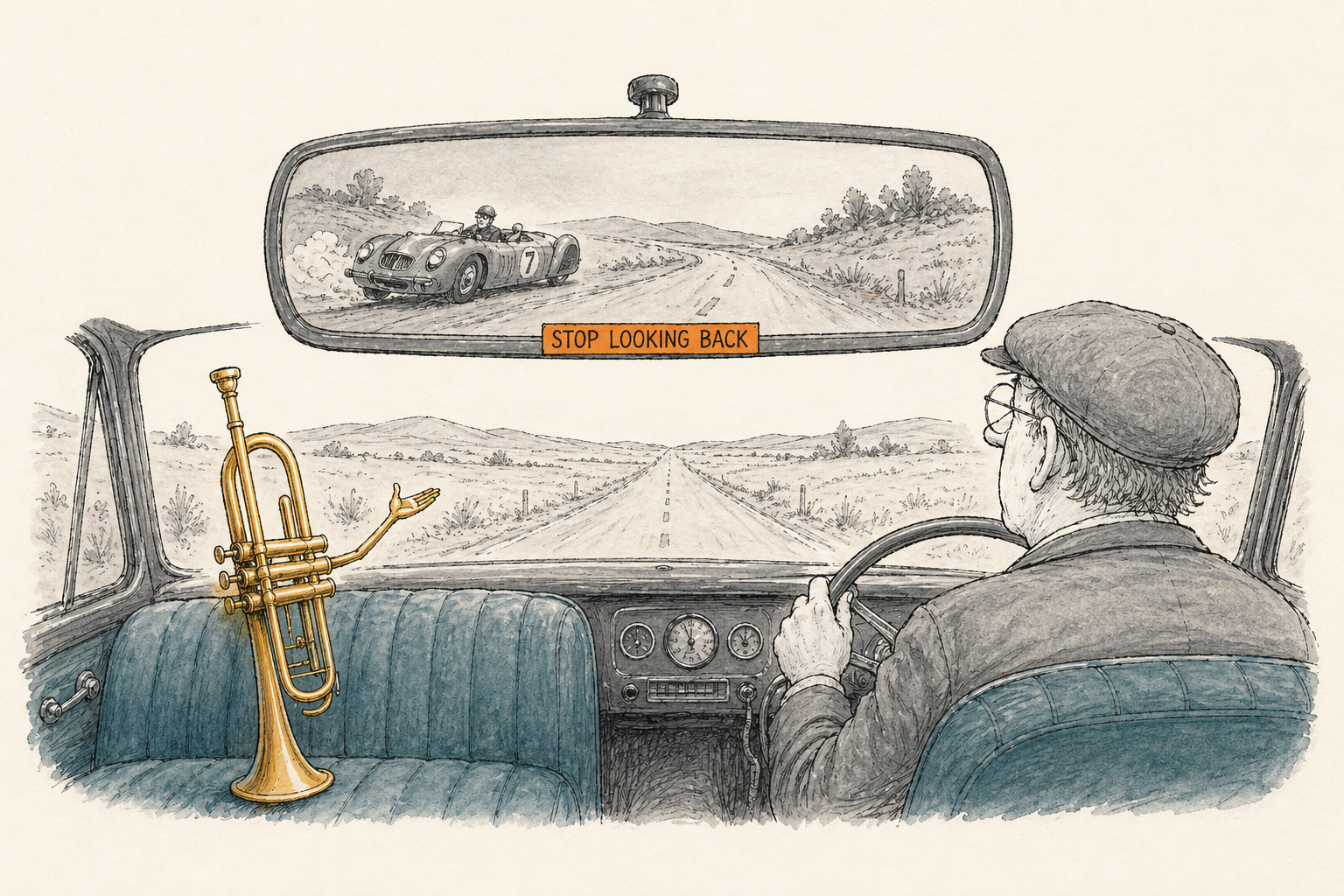
When you come back to the trumpet, you’re carrying an identity from your past. You were a trumpet player — in school, in the military, professionally, wherever. You had a level. You had a sound. You had things you could do. And now you pick up the horn and none of that is there anymore.
So what happens? You start measuring every note, every session, every sound against that old version of yourself. And you fail the comparison every single time. Because of course you do — you haven’t played in years. But knowing that intellectually doesn’t stop the emotional gut-punch of hearing yourself sound like a shadow of what you used to be.
Here’s the thing most comeback players don’t realize: this identity trap isn’t even unique to comeback situations. I see it in active players all the time. Think about the last time you hit a new high note. What happened? You immediately claimed it. “That’s my note now. I should be able to do that every day.” You took a personal record — a peak moment — and made it your new expected average. And then every time you couldn’t hit it on demand, you felt like something was wrong.
That’s not how progress works. A PR is an indication of what’s possible, not a new baseline. And for comeback players, this tendency is amplified by a thousand because the gap between the memory and the reality is so much wider.
But there’s a second version of this trap that’s equally destructive, and it goes the other direction. Some comeback players adopt the identity of “comeback player” and then stay there. Forever. It becomes their excuse blanket for everything: “Well, I’m a comeback player, so this is just harder for me.” “I’m too old for this.” “My chops aren’t what they used to be.” “My lips don’t respond the same way.” “I’ve been away too long — maybe I just don’t have it anymore.”
You know what all of those statements have in common? They’re identity statements disguised as facts. And they become self-fulfilling prophecies. If you believe you’re someone who can’t do this, your actions will confirm that belief every single day.
So what’s the answer? You need to borrow an identity from the future.
Not from the past — that player is gone. And not from the present — “struggling comeback player” is not an identity that drives winning behaviors. From the future. Who is the trumpet player you’re becoming?
James Clear talks about this in Atomic Habits, and it applies perfectly here. Every action you take is a vote for the type of person you want to become. If you want to become a consistent, capable, musical trumpet player — what does that person do? They practice every day. They track their progress. They stay patient. They approach the horn with a beginner’s mindset, which doesn’t mean playing like a beginner — it means being willing to question assumptions, make mistakes deliberately, and learn from everything.
Think about a smoker trying to quit. If their identity is still “I’m a smoker who’s trying not to smoke,” what are they doing? They’re counting days. And counting implies the streak is going to break. Counting implies it’s hard, that they’re resisting something they want. But if their identity shifts to “I’m not a smoker” — genuinely, at the core level — there’s nothing to count. There’s nothing to resist. The behavior aligns with the identity automatically.
Same thing with your trumpet comeback. If your identity is “I’m a former player trying to get back to where I was,” you’re counting. You’re resisting. You’re measuring backward. But if your identity is “I’m a trumpet player who’s building something great” — the behaviors follow naturally. The daily practice happens because that’s what trumpet players do. The patience comes because you’re building, not recovering.
Now, your future identity has to be realistic. You can’t adopt the identity of Wynton Marsalis if you’re not willing to put in five hours a day for the next twenty years. But you can adopt the identity of someone who plays well, plays musically, plays consistently, and enjoys the instrument. Figure out what your ambitions actually are, and let your identity match. If you want to push a little beyond that — aim for the stars, hit the moon — that’s fine. Just make sure the identity is pulling you forward, not anchoring you to the past.
One more layer here, and it’s important. If your identity is too wrapped up in trumpet playing — if the trumpet is everything to you, if your sense of self rises and falls with every practice session — you’re in trouble. I’ve been there. There was a time in my life when trumpet was above everything. Above relationships, above health, above my livelihood. And it crushed me. When a bad day on the trumpet means your entire day is ruined, when your self-worth is tied to whether you cracked a note during warm-up — something is out of balance.
It wasn’t until I put trumpet in the right layer of my identity that I actually started to flourish as a player. Something I care deeply about, something I pursue with discipline and joy, but not the thing that defines my entire worth as a human being. Trumpet can’t go above God, above your family, above your health, above your livelihood. It has to be placed in the right domain. And paradoxically, when you put it in the right place — when you stop white-knuckling your entire identity around this instrument — you actually play better. The pressure drops. The joy comes back. And the music flows the way it’s supposed to.
Mistake #2: Pushing Too Hard, Too Early
You’ve been away for years. Maybe decades. You feel the urgency. You feel like you’ve missed out on so much playing time, and now you need to make up for it. So you push. Hard. From day one.
This is the fastest way to destroy your comeback.
Think about it this way. Imagine you were in a coma for ten years. Everything has atrophied. You wake up and you can barely move. Are you going to walk into the gym on day one and try to deadlift 300 pounds? Of course not. You’d do physical therapy. Your goal wouldn’t be strength — it would be coordination. Just move. Just get the signals firing again. And then slowly, slowly build from there.
Your trumpet comeback works the same way. Not because your lip muscles have atrophied — you use your face every day — but because trumpet playing is a fine motor skill. It’s not about brute strength. It’s about coordination, balance, and precision. And you cannot force your way to precision. It doesn’t work.
Here’s the gym analogy that really drives this home. If you have terrible deadlift form — if you’re lifting entirely with your lower back and your spine — you might be able to muscle through some weight. But you’re only using a fraction of your available musculature. Your glutes, hamstrings, abs, upper back — none of them are contributing because the form isn’t there to recruit them. And the second you go even a little bit heavy, you get hurt. Not because you’re weak, but because your coordination can’t support the load.
Trumpet works exactly the same way. You can have a block of muscle on your face, but if you don’t know how to use it — if the coordination isn’t there — that muscle is wasted. Worse, it works against you, because uncoordinated effort triggers the protective reflex. Your body registers the strain as a threat, and it starts shutting you down before you even get started.
So before you start using force, you need the finesse to facilitate it. Calibrate. Coordinate. Get re-familiarized with this instrument. Stay within your range pyramid and build your practice around skill development, not power. The strength comes later, and when it does, it’ll have somewhere useful to go.
Mistake #3: Doubling Down After Overdoing It
Here’s what’s going to happen. Despite everything I just said, you’re going to overdo it. Everybody does. You’ll have a great day, get excited, push too far, and wake up the next morning with chops that feel like concrete.
And then you’ll make the real mistake: you’ll double down.
You’ll feel like you lost something. Like those dead chops mean you went backward. So you’ll practice more. Longer. Harder. You’ll dig in, trying to force your way back to where you were yesterday.
This is like going to the gym with a pulled muscle and doing the exact exercise that pulled it, but heavier. It’s insane when you say it out loud, but trumpet players do it every single day.
When you overdo it and your chops are wrecked, the answer is less, not more. Light day. Easy playing. Fundamentals only. Or take the day off entirely. Your body is telling you something. Listen to it. The recovery is where the growth happens — not the grinding.
Mistake #4: Using Compensatory Mechanisms to Shortcut Progress
Your body is smart. Maybe too smart. When you want to play a note and you don’t have the technique to do it efficiently, your body will find another way. Any way. And those workarounds — what I call compensatory mechanisms — will ruin your comeback if you let them.
Here’s how it shows up: You want more range, so you press the mouthpiece harder into your face. You want more volume, so you overblow. You want more control, so you pinch your lips tighter. You want more compression, so you close your throat. You want a quick fix, so you buy a new mouthpiece, a new horn, a new gadget, a resistance trainer, some miracle device you saw advertised online.
Every one of these works a tiny bit. That’s the trap. Mouthpiece pressure does help you squeak out a higher note — while simultaneously cutting off blood flow to your lips and guaranteeing that you’ll have less endurance every single day you play. Throat tension does create a feeling of compression — while choking your sound and triggering the protective reflex. A new mouthpiece does feel different for a week — until you realize you brought all the same habits with you.
The compensatory mechanism always costs more than it gives. Always. And the reason players fall for them is that they deliver a small, immediate result that feels like progress. But they’re borrowing from your future to pay for today.
The fix isn’t to try harder. It’s to figure out the easiest way to play the note. If you can’t play it easily with good form, the answer isn’t to force it with bad form. The answer is to back up, build the foundation, and let the note come to you when your technique can support it.
Mistake #5: Inconsistent Practice
I’d rather you practice 15 minutes a day, every single day, than one hour every other day. Even though the math says the every-other-day approach gives you more total time, it doesn’t matter. Consistency beats volume every time.
Here’s why. Trumpet playing is built on muscle memory. Muscle memory is built through daily repetition. When you skip a day, your nervous system doesn’t just pause — it starts to lose the calibration you built yesterday. Then when you come back and play for an hour, you spend the first 20 minutes just getting back to where you were, and the remaining 40 minutes is compromised by fatigue because you’re playing too long in one sitting.
Fifteen minutes every single day keeps the signals firing. It keeps the coordination fresh. It builds the kind of deep, automatic muscle memory that actually sticks. And it’s sustainable — anyone can find 15 minutes.
The comeback players who succeed aren’t the ones who have the most dramatic practice sessions. They’re the ones who show up every day, even when it’s boring, even when it’s only 15 minutes, even when they don’t feel like it.
Mistake #6: Not Getting Help (And the Excuses That Keep You From It)
This one kills me because I hear the same two excuses over and over.
The first one: “I need to prove to myself that I’m going to stick with this before I invest in a teacher or a program.”
If that’s where your head is, you’ve already lost. You’re telling yourself that you might quit — and you’re building an off-ramp into your comeback before you’ve even started. Commitment doesn’t come after proof. Commitment comes first, and the proof follows. You don’t wait until you’re in shape to hire a personal trainer. You hire the trainer because you need help getting in shape.
The second excuse: “I need to get to a certain level first. I need to be closer to where I was before anyone can really help me.”
This one is even more backwards. Right now — at the very beginning of your comeback — is when you need help the most. This is where the bad habits get built. This is where the compensatory mechanisms get locked in. This is where a wrong turn costs you six months instead of six days. If you wait until you’ve “gotten somewhere” on your own, there’s a very good chance you’ll arrive with a suitcase full of problems that now have to be unlearned before you can move forward.
Get the help now. Not when you feel ready. Not when you’ve earned it. Now. Set yourself up properly from the beginning instead of spending months building habits that someone will eventually have to dismantle. Figuring it out yourself vs. getting a teacher isn’t even a close contest when you’re at the starting line of a comeback.
Mistake #7: Chasing High Notes Too Early
I know. You used to be able to play a high C. Or a double C. Or whatever your ceiling was. And now you can barely get above a G on top of the staff, and it’s driving you crazy.
So you start reaching for it. You sneak up into the upper register during your warm-up. You push just a little higher each day. You tell yourself you’re “just testing” or “just seeing where it is today.”
You’re not testing. You’re triggering compensatory mechanisms and the protective reflex. You’re teaching your body that playing trumpet requires strain, force, and struggle. And you’re burning through your limited endurance on notes that aren’t serving your comeback.
Anything that’s difficult is off-limits right now. And for a comeback player, “difficult” might mean the middle of the staff. That’s okay. Stay within your range pyramid — your lowest comfortable high note and below. Build the coordination. Build the efficiency. Build the foundation. The high notes will come as a byproduct of good technique, and when they do, they’ll be easy and sustainable instead of forced and fragile.
Mistake #8: Not Tracking Your Practice
This one is sneaky because it doesn’t feel like a mistake. It feels like a minor detail you can skip. But not tracking your practice is like trying to lose weight without tracking what you eat.
You can eat perfectly all week — clean meals, right portions, discipline that would make a monk proud. And then Friday night you eat an entire pizza and a pint of ice cream and you’ve wiped out your deficit for the whole week. If you’re not tracking, you don’t even realize it happened. You just wonder why the scale isn’t moving.
Trumpet practice works the same way. You can have five great sessions in a row, and then one session where you push too hard, stay too long, and practice fatigued — and you’ve undone a significant chunk of the progress you built. If you’re not tracking, you don’t see the pattern. You just feel like you’re stuck and you don’t know why.
At minimum, track three things. First, your practice streak — how many consecutive days you’ve practiced. This is your single most powerful motivational tool. Once you’ve got a 14-day streak going, you don’t want to break it. It gives you something to protect, and that protection becomes the driver that compounds your improvement. Second, your intensity — was it a light day, a medium day, or a heavy day? This tells you whether you’re recovering properly or grinding yourself into the ground. Third, a quick note about how it went. One sentence. That’s it.
There are dozens of other things you can track — response quality, range ceiling, endurance duration, specific exercises, tempo progress — like a personal trainer would track for an athlete. Those details keep your chops safe and your progress visible. But in the beginning, just track the streak, the intensity, and a sentence. If you do nothing else, do that. Because if you’re not tracking it, you’re guessing. And guessing is how you end up six months into a comeback with nothing to show for it.
Mistake #9: Gear Chasing Instead of Skill Building
I like gear. I’m not going to pretend I don’t. There’s something fun about trying a new mouthpiece, testing a new horn, experimenting with different setups. And there’s absolutely a time and place for all of that.
The beginning of your comeback is not that time.
Here’s what happens. You sound bad. You feel frustrated. So you start thinking maybe the equipment is the problem. Maybe this mouthpiece is too small. Maybe the horn isn’t responding right. Maybe you need a shallower cup, or a wider rim, or a different backbore. You go on a trumpet forum — which, by the way, is a terrible idea during a comeback — and someone recommends a mouthpiece that “changed everything” for them. So you buy it. And it feels different for about four days. And then it feels exactly the same, because you brought all of your habits with you.
So you try another one. And another. And before you know it, you’ve spent $500 on mouthpieces and you still can’t play a clean G on top of the staff.
The equipment is not the problem. You are the problem. And I say that with love, because I’ve been the problem too. We all have. Gear chasing is the most socially acceptable form of procrastination in the trumpet world. It feels like you’re doing something productive. You’re “optimizing your setup.” But what you’re actually doing is avoiding the hard, boring, unglamorous work of rebuilding your fundamentals.
Here’s what you need for a comeback: a mouthpiece that’s not too big and not too small, on a trumpet that’s in decent shape with valves that work. That’s it. Play on that for 60 days before you change a single thing. If you still want to experiment after your fundamentals are rebuilt, go for it — at that point you’ll actually be able to feel the differences because you’ll have a calibrated system to evaluate them with. Right now, you don’t.
Mistake #10: Information Overload (The Stimulus Hunting Trap)
This one is a modern problem, and it’s killing more comebacks than ever before.
You start your comeback. You want to do it right. So you go on YouTube and watch twelve videos about embouchure. Then you read six forum threads about breathing. Then you buy a method book someone recommended. Then you watch another video that contradicts the first twelve. Then you find a blog post that introduces a completely different approach. Then you’re on Reddit and someone swears by a system you’ve never heard of.
And now you’re paralyzed. Or worse — you’re not paralyzed, you’re hopping. You try one approach for three days, don’t see results, and switch to another. Then another. Then another. You’re cycling through methods like a kid flipping through TV channels, never watching anything long enough to know if it’s good.
I call this stimulus hunting, and it’s the opposite of what actually makes people better. What makes people better is committing to one system and working it. Boring, repetitive, unsexy work on the same fundamentals, day after day, for weeks. That’s how muscle memory gets built. That’s how coordination develops. That’s how the nervous system recalibrates.
Your biggest weakness in the beginning is going to be response and coordination. That’s it. That’s the one thing you should be working on. Not range. Not endurance. Not tone color. Not jazz articulation. Response and coordination. If you can commit to that single focus for the first 30 to 60 days and ignore everything else — every YouTube rabbit hole, every forum debate, every shiny new method — you will be in a dramatically better position than the player who tried to learn everything at once and learned nothing.
Pick a system. Work it. Stop consuming and start doing.
Mistake #11: Practicing Fatigued and Calling It “Discipline”
This is different from pushing too hard. This is the player who knows their chops are done — who can feel that the endurance is gone, that the response is sluggish, that every note is requiring more effort than it should — but keeps going anyway because they think stopping early means they’re being lazy.
“I committed to 30 minutes, so I’m doing 30 minutes.”
“Real players push through.”
“No pain, no gain.”
Wrong. Wrong. And catastrophically wrong.
There is a critical difference between discipline and self-destruction, and on the trumpet, that line is thinner than you think. Discipline is showing up every day. Discipline is following your warm-up sequence when you’d rather skip to the fun stuff. Discipline is tracking your practice when you don’t feel like it. That’s discipline.
Playing through genuine fatigue — when your chops are telling you they’re done, when you can feel the compensations creeping in, when the sound is getting thinner and the pressure is increasing — that’s not discipline. That’s ego. And it’s programming bad habits directly into your muscle memory with every rep you play.
When your chops are cooked, the quality of every repetition drops. Your body starts compensating — more pressure, tighter throat, pinched lips — just to produce sound. And those compensations are being logged by your nervous system as “this is how we play trumpet.” You’re literally training yourself to play with bad habits, and then wondering why things aren’t improving.
When your chops say stop, stop. Make it a light day. Work on breathing exercises, visualization, fingering patterns without the horn, or just call it and walk away. A shorter session at high quality is infinitely more valuable than a long session where the last fifteen minutes are garbage. The discipline is in knowing when to stop. That’s the hard part. Anyone can grind. Smart players know when to rest.
The Pattern Behind All of These Mistakes
If you look at this list, there’s a thread running through every single mistake: they all feel like the right thing to do.
Pushing hard feels like effort. Doubling down feels like determination. Compensatory mechanisms feel like problem-solving. Grinding through fatigue feels like discipline. Gear chasing feels like optimization. Information gathering feels like preparation.
And that’s exactly why these mistakes are so insidious. They wear the costume of progress. They give you the emotional satisfaction of “working hard” while systematically undermining the actual work that needs to happen.
The real work of a trumpet comeback is quieter than you expect. It’s patient. It’s precise. It’s often boring. It’s 15 minutes of careful fundamentals, tracked in a notebook, done consistently, within your limits, with the right identity driving the whole machine.
That’s not sexy. But it’s what works.
If you want the complete system — the step-by-step rebuild for your first 30 to 60 days, including the range pyramid, the 2:1 practice ratio, the layered warm-up sequence, and everything else — read the Complete Trumpet Comeback Guide. It’s free, it’s thorough, and it’s built for exactly where you are right now.
Watch the Free Training: “Why Your Trumpet Playing Got Worse (And the 3-Step System to Fix It)”
If this article got you fired up, the free training goes deeper. The same diagnostic-first system used inside the 1% Trumpet Program — the protective reflex framework, the 2:1 ratio in action, and the systematic rebuild that actually works for adult players.
And if you already know you want help — real help, not another YouTube video — we should talk. The 1% Trumpet Program is a year-long nervous system retraining system built specifically for players like you. Diagnosis first, personalized coaching, daily accountability, and a community of comeback players who get it. No guessing. No spinning your wheels. Just a system that works.
About the Author
Jesse Garcia
Founder, 1% Trumpet Program
Jesse is a working trumpeter and teacher. He’s performed with the Glenn Miller Orchestra, freelanced on the Las Vegas commercial scene, played extended cruise ship contracts around the world, and served as a trumpeter in the United States Army. He’s worked hands-on with over 100 trumpet players — from beginners to comeback players to seasoned pros — and reaches an audience of 75,000+ across his social platforms. He founded the 1% Trumpet Program to teach what actually works for adult players, drawing on the same systems he uses to keep his own chops sharp on the road.
Want the full system in 30 minutes? Watch the free training — the same diagnosis-first framework I use with every player in the 1% Trumpet Program.
RELATED READING
- Lip Compression on Trumpet — most comeback mistakes are the wrong compression vector. Four directions, four risks.
- Embouchure Stopped Working? — the diagnostic for the chops crisis most comeback players hit.
- The Complete Embouchure Guide — the map most comebacks fail without.