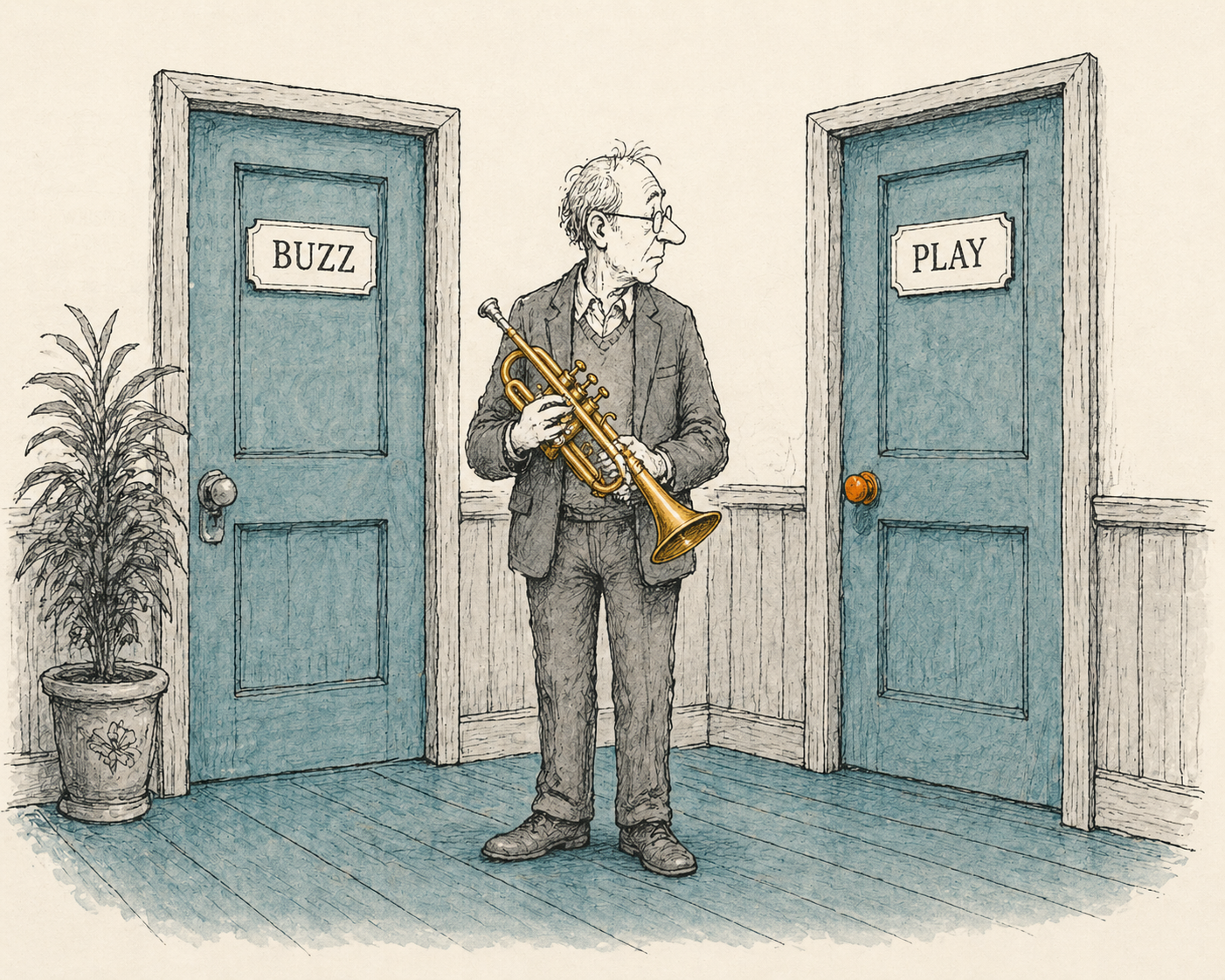
Here’s my whole position on mouthpiece buzzing trumpet endurance work in five lines.
Mouthpiece buzzing is fine. Don’t overdo it. Use it as part of warmup, in small doses. Use it as bonus practice, in small doses. And if you’re not really paying attention to what you’re doing, don’t do it.
That’s the article. The rest is just me filling in why.
If you want the broader take on whether to buzz at all, outside the endurance frame, I wrote a separate piece called To Buzz or Not to Buzz: The Mouthpiece Question. That one carries the full debate. This one stays narrow: how does buzzing fit into your endurance work, and where does it belong in your routine?
Mouthpiece Buzzing Trumpet Endurance Work Is the Side Dish, Not the Main Course
The horn is the main event. Everything else is supporting work.
Think of it like the difference between a hand stretch and a workout. If you’re a pianist, you stretch your hands before you play. The stretch is useful. It loosens you up. It primes the tissue. But if you spent an hour stretching and ten minutes playing scales, you’d be doing the wrong thing. The stretch is preparation for the work. It is not the work.
Mouthpiece buzzing is the same. It can prime things. It can do a small diagnostic check. It can give you a quiet way to put a few extra minutes of intentional focus into your face when you can’t get to the horn. All of that is real. None of it replaces actual horn time, and none of it should eat very much of your daily vibration budget.
The players who get into trouble with buzzing are the ones who turned the side dish into the main course. They buzz for fifteen minutes before they ever pick up the horn. They buzz in the car. They buzz between sets. They’ve made it a religion. And their chops still fall apart at the same place they always did, because the religion was never going to fix the playing.
What Buzzing Can Actually Do Well
Used briefly and on purpose, mouthpiece buzzing has a few honest jobs.
It can reinforce your embouchure. A short, focused buzz lets you feel air and aperture coordinating without the horn cushioning the work. If you do it intentionally, you can use that information when you go to the trumpet.
It’s a diagnostic for whether your buzz physics are honest. If the buzz wanders pitch, splatters, or won’t sit centered, something is off in the source. The trumpet often covers for that. The mouthpiece is more naked. So if the buzz is messy in low to middle range at a soft volume, that’s information you can use.
It pairs well with the rest of the gentler work. Low notes, leadpipe buzzing, soft mouthpiece work. These tend to cluster naturally. They’re all low-stakes ways to keep the lips vibrating without recruiting bad-source compression. A minute or two of mouthpiece buzzing inside a larger calibration block is fine. It plays nice with the other quiet stuff.
That’s about it. It’s a useful, limited tool.
What Buzzing Does Badly
The same tool, used wrong, can hurt you in three pretty consistent ways.
Overdone, it builds bad habits. Same training rules as everything else. You can absolutely overdo it. Once you cross from “small dose” into “this is half my routine,” you’re racking up reps with very little feedback, and reps without feedback tend to calcify whatever your face was doing. If your face is doing something good, fine. If it’s doing something bad, you just made the bad thing more automatic.
Done without attention, it locks in whatever physics you happened to bring. This is the big one. If you buzz on autopilot in the car or while you’re scrolling your phone, you’re not training anything. You’re rehearsing. And rehearsing without attention is how players spend years getting more efficient at the wrong things.
Treated as a substitute for horn time, it hurts more than it helps. The horn is the instrument that gives feedback. The mouthpiece is a fragment of the instrument that gives less feedback. If you trade horn minutes for mouthpiece minutes because the mouthpiece is quieter or more convenient, you’re spending the same fatigue budget on lower-quality reps. The math doesn’t work.
The Attention Test
If there’s one rule that decides whether buzzing is helping you or hurting you, it’s this. Are you paying attention?
If you’re sitting upright, listening to the pitch, watching whether the buzz is clean and centered, comparing what you feel to what you want to feel, that’s productive buzzing. Two minutes of that is more useful than thirty minutes of distracted buzzing.
If you’re driving, scrolling, talking, half-watching a show, or thinking about lunch, put the mouthpiece down. Read a book. Stretch. Breathe. You’ll do less damage doing nothing than you will buzzing on autopilot.
That’s the gate. Buzz with your full attention or don’t buzz.
How I Actually Use It
In practice, here’s how this lands inside a routine.
As part of warmup, a minute or two at the very start, low to middle range, soft, focused, in tune. Then go straight to the horn while the coordination is fresh. The buzz is the check-in. The horn is the workout.
As bonus practice, occasional and short. If you’re sitting in a green room or a quiet space and you actually want to put a couple of focused minutes into your air-aperture connection, that’s fine. The keyword is “focused.” If your attention is anywhere else, skip it.
That’s the whole prescription. Small doses, real attention, then back to the horn. If your endurance is stuck and you’ve been buzzing for fifteen minutes a day, try cutting it down to two minutes for a few weeks and put the saved time on the horn. Most players who make that swap report cleaner playing and faster recovery, not because the buzzing was magic, but because the no-feedback reps were quietly costing them.
Recovery, Briefly
One last note. Buzzing counts against your daily vibration budget. Every minute you spend buzzing is a minute your face spent vibrating, and the face only has so many minutes in it before fatigue compounds.
So if you’ve already had a long day on the horn, the answer is rarely “go buzz some more.” The answer is rest. That can mean a true day off the horn, or it can mean a light day where you do gentle, low-volume work that acts as recovery. Both options are valid. Younger or more anxious players sometimes do better with a light day than a hard day off, because total silence makes them tense. Older or more beat-up players sometimes need the actual day off. There’s no one right answer, but more buzzing is rarely it.
Use the tool. Don’t worship it. The rest is just paying attention.
— Jesse
“Different teachers say different things about buzzing. Who do I believe?” The reason teachers disagree about buzzing isn’t that buzzing is mysterious. It’s that they’re each watching a different set of bodies under different conditions and reporting back what they saw. A method only matters when the player has the diagnostic awareness to read whether it’s working for THEIR body. Without that diagnostic layer, every method is a coin flip. You read the article, you try the exercise, you have no idea if it’s working. That’s how players spend years jumping from one teacher’s pet exercise to another and never build any cohesion. In this 30-minute training, I walk through the system that reads your body, not just hands you a method. So the next time a teacher gives you advice, you can tell whether it’s the right advice for you.